So, how should we react to this possible threat to our planet’s climate future? Under the IPCC’s SSP5-8.5 worst-case scenario, we can expect an increase in annual mean global temperature between 3.3°C and 5.7°C (5.9 to 10.3 °F) by 2100. This level of predicted warming is about 450–850% greater than the increase in the global annual mean temperature observed during the 20th century (0.6°C or 1.1°F). Some possible environmental effects that could arise from this worst-case scenario level of global warming are as follows (IPCC, 2022):
Changes to Weather and Climate
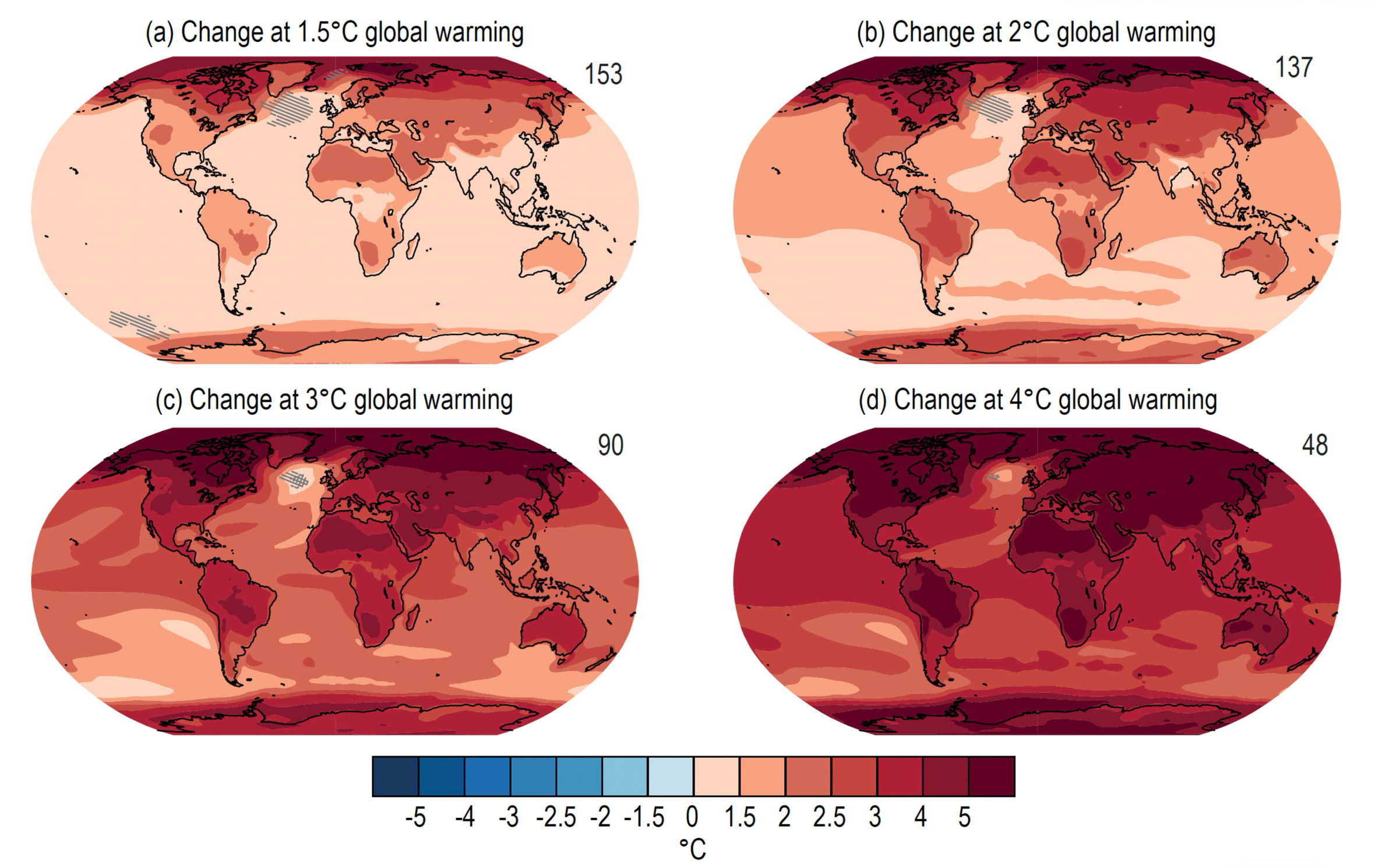
- Average annual temperatures would be 3 to 7°C (5 to 13°F) warmer in mid-latitude land locations and about 5 to 11°C (9 to 20°F) warmer in the Arctic (Figure 1).
- A warmer planet would increase water evaporation, leading to higher precipitation in many parts of the world. Climatologists have already documented a 10% increase in precipitation over the middle and higher latitudes of the Northern Hemisphere from 20th-century global warming.
- Hurricane intensity and frequency would increase in tropical and subtropical regions.
- Southeast Asia and Central Africa may experience stronger monsoons, leading to more precipitation in some areas.
- An increase in the frequency of severe thunderstorms in middle latitudes increases the likelihood of tornadoes, hail, and flooding.
Plants, Animals, and Biome Changes
- The geographic extent of Earth’s major biomes will change. Some biomes, like the tundra, will shrink, while others, like the tropical rain forest, will expand.
- The area occupied by the present North American grasslands may receive less rainfall, increasing the frequency and severity of drought. This change will also alter species dominance, favoring organisms that can better withstand scarce water availability.
- Coniferous forests of Alaska, Canada, and Russia will move further north into areas now occupied by tundra as climates become milder.
- Many animals and plants will be forced to migrate and shift their geographic ranges to adapt to a warmer climate and changing precipitation patterns. Those that cannot migrate may become extinct.
- Changes in the geographic ranges of plants and animals will be most severe in the higher latitudes because of greater temperature fluctuations and possibly altered precipitation patterns.
- Rising sea temperatures could destroy more of our planet’s coral reefs.
- Organisms living in relatively isolated mountains and mountain ranges will be severely limited in their ability to migrate to find suitable new habitats.
- The species composition of inland fisheries will change as lakes and streams warm and discharge patterns change.
Changes to the Hydrology of the Planet
- Rising sea levels due to ocean thermal expansion and melting glaciers and ice caps could lead to flooding in coastal regions.
- Water levels in many lakes will fluctuate with variations in precipitation and evaporation.
- Changes in water supply and storage will modify human water withdrawal and consumption for domestic, industrial, and agricultural purposes.
- Modifications in the flow of runoff may affect hydroelectric power generation.
- Glaciers will continue to retreat worldwide. The glaciers on Mount Kilimanjaro, Tanzania, Africa, could be entirely gone by 2050.
- Mountain snowpacks will see reductions that, in turn, will affect spring and summer runoff supplies to adjacent lowlands.
- The area covered by sea ice in the Arctic and adjacent to Antarctica will shrink considerably.
Human Health Effects
- Warmer temperatures may decrease deaths associated with cold weather. This effect will be more than offset by the increase in mortality related to extreme heat. Hospital data indicate that mortality rates increase substantially with extreme maximum daily temperature events and heat waves. Such extreme maximum daily temperature events and heat waves will become more common in many parts of the world.
- The risk of tropical and subtropical infectious diseases will increase. Vector-borne diseases, including malaria, dengue fever, yellow fever, and encephalitis, will spread poleward as their insect vectors move northward.
Human Built Environment and Agriculture
- Urban areas will get warmer, increasing the need for air conditioning.
- Residential heating needs will decrease in many locations around the world.
- Some agricultural practices will have to change due to the lengthening of the growing season and changes in precipitation patterns.
- Warmer temperatures at high latitudes will cause permafrost to melt, creating construction problems with homes, roads, and pipelines.
References
IPCC. 2021. Climate Change 2021: The Physical Science Basis. Contribution of Working Group I to the Sixth Assessment Report of the Intergovernmental Panel on Climate Change [Masson-Delmotte, V., P. Zhai, A. Pirani, S.L. Connors, C. Péan, S. Berger, N. Caud, Y. Chen, L. Goldfarb, M.I. Gomis, M. Huang, K. Leitzell, E. Lonnoy, J.B.R. Matthews, T.K. Maycock, T. Waterfield, O. Yelekçi, R. Yu, and B. Zhou (eds.)]. Cambridge University Press, Cambridge, United Kingdom and New York, NY, USA, 2391 pp.
IPCC. 2022. Climate Change 2022: Impacts, Adaptation and Vulnerability. Contribution of Working Group II to the Sixth Assessment Report of the Intergovernmental Panel on Climate Change [H.-O. Pörtner, D.C. Roberts, M. Tignor, E.S. Poloczanska, K. Mintenbeck, A. Alegría, M. Craig, S. Langsdorf, S. Löschke, V. Möller, A. Okem, B. Rama (eds.)]. Cambridge University Press, Cambridge, UK and New York, NY, USA, 3056 pp.