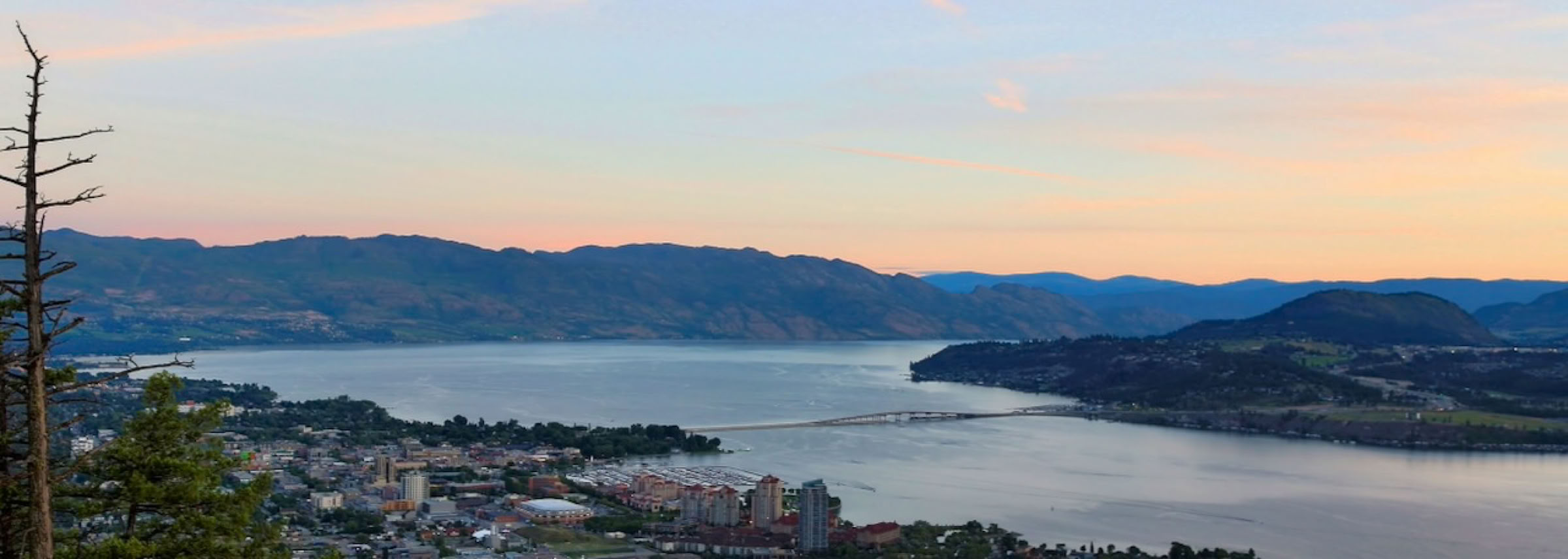
Climate Change in the Okanagan
Understanding how human-induced climate change will impact the future air temperature and precipitation patterns in the Okanagan region (Kelowna, Penticton, Summerland, and Vernon) is crucial for the people living in this part of Canada. These four cities are located in one of the most climate-vulnerable regions in Western Canada, making the consequences of climate change particularly concerning. The effects will be felt in various aspects of Okanagan life, including the risk of wildfires, water shortages, agriculture, tourism, recreation, and public health. As an Okanagan resident, I am deeply concerned about the environmental impacts of continued global warming and associated climate change. Therefore, this website was created to engage the Okanagan community in this important environmental issue.
By analyzing the impact of human-induced climate change on these communities, we can develop effective adaptation strategies. This information also empowers citizens to identify the most effective approaches to reducing greenhouse gas emissions in the future. The four Okanagan cities examined have an excellent record of daily climate data collected by Environment and Climate Change Canada. I have analyzed this historical data from 1951 to the present for each city to identify any observable trends in surface air temperature and precipitation.
This site offers some general information about human-induced climate change and how to recognize its appearance, which can be accessed from the Background link. This information is organized into six webpages:
For each of the four Okanagan cities—Kelowna, Penticton, Summerland, and Vernon—climate change-related information is organized on the following five webpages:
Finally, from the Forecast link, I provide the latest long-range forecast of temperature and precipitation trends for the next three months. This information was gathered from the National Oceanic and Atmospheric Administration’s Climate Prediction Center for North America. These forecasts are generated by analyzing the output of seven advanced climate models, including Canada’s CanESM5 model, as found on the North American Multi-Model Ensemble webpage. This information will be updated by the 10th day of each month.
Additional Educational References
Berners-Lee, M. 2025. A Climate of Truth. Cambridge University Press. Amazon Canada. This academic researcher argues that the climate crisis stems less from technological limitations than from the pervasive deceit and financial graft that exists in our society. He suggests that only by embracing honesty in our politics, corporate actions, media story telling, and everyday thinking can society mobilize the solutions already available.
City of Kelowna. 2024. Climate Resilient Kelowna Strategy.
Dessler, Andrew E. 2021. Introduction to Modern Climate Change, Third Edition. Amazon Canada. Is a well-written university undergraduate‑level introduction to the science, impacts, and policy dimensions of modern climate change.
Figueres, Christiana and Rivett-Carnac, Tom. 2021. The Future We Choose: The Stubborn Optimist's Guide to the Climate Crisis. Amazon Canada. Is a strategic and hopeful guide to how society can fix the climate crisis.
Mann, Michael E. 2022. The New Climate War: The Fight to Take Back Our Planet. Amazon Canada. Is a careful analysis of how powerful political and corporate interests have shifted from denying climate science to deploying new, more sophisticated tactics that delay environmental action.
Mann, Michael E. and Kump, Lee R. 2015. Dire Predictions: Understanding Climate Change, Second Edition. Amazon Canada. Is a clear and scientifically sound guide to the causes, impacts, and future effects of climate change using the findings of the Intergovenmental Panel on Climate Change (IPCC).
Regional District of Okanagan-Similkameen. 2020. Climate Projections for the Okanagan Region.
Thompson, V., Kennedy-Asser, A.T., Vosper, E., Lo, Y.T.E., Huntingford, C., Andrews, O., Collins, M., Gabrielle C. Hegerl, G.C,. & Mitchell, D. 2022. The 2021 western North America heat wave among the most extreme events ever recorded globally. Science Advances, 8 (18), eabm6860. https://doi.org/10.1126/sciadv.abm6860
White, R.H., Anderson, S., Booth, J.F., Braich, G., Draeger, G., Fei, C., Harley, C.D.G., Henderson, S.B. , Jakob, M., Lau, C.-A., Admasu, L.M., Narinesing, V., Rodell, C., Roocroft, E., Weinberger, K.R., & West, G. 2023. The unprecedented Pacific Northwest heatwave of June 2021. Nature Communications, 14, 727. https://doi.org/10.1038/s41467-023-36289-3
Copyright © 2026 Michael Pidwirny